Freshwater fish
The Greatest Beer Run Ever: A Memoir of Friendship, Loyalty, and WarFreshwater fish are more than a resource in the narrator’s childhood world: they draw together the practical economies of the household, the pleasures of companionship, and the freedom of being alone on the water. Eels, roach, perch, and pike recur in scenes across the canal, the lake, and the River Shannon, where fishing makes the landscape legible through particular places, methods, and catches.
Fish in the Local Landscape
The fish first appear as part of a living network of waterways. On a visit to the McGarrys, the canal running along their fields is described as full of eels, bright yellow roach, and small perch. The narrator and his cousins catch perch there, making the canal both a habitat and a place of play. Their day also extends along a lake shore where a setline for pike is fastened to a bottle floating beyond drowning leaves. The details distinguish different kinds of fishing: fish are present in the water, but the setline is already a deliberate means of seeking a larger catch.
The wider river landscape is equally specific. Near Oakport Estate, the narrator recognizes the Gut, the navigation signs, the reeds, and the edges where fish might be found. Water is not merely scenic background: its current and depth affect whether a line has any chance of taking a fish. A fishing place must be read as carefully as it must be reached, with the moving boat, the bank, and the submerged terrain all shaping the attempt.
Methods, Catches, and Shared Outings
Fishing from the Tarred Boat brings together the narrator, Katie McManus, and Peter McLoughlin on a Sunday outing. Peter rows while the narrator lets out the spoons, and Katie holds a line. The narrator warns that the light may be too bright for a fish to take the bait; his attention is fixed on the practical conditions of fishing even as his companions tease him for his seriousness. When the boat moves too fast and too far into the current, he asks Peter to slow and steer closer to the reeds and drowning leaves. The day’s route passes the navigation pans at the Gut and a timber-loading platform before they reach Tohran’s Island.
That first stretch produces no fish. The narrator then proposes trying for perch, which are regularly found in that area and at the Golden Bush. With a jam jar of worms and two fishing poles, he rows to Tohran’s Island while Katie and Peter go ashore to look for strawberries. He catches several perch, all small, in clear water over flagstones. The fish run with the worm across the stone, making them difficult to hook but enjoyable to pursue. His catch is modest, yet the episode gives fishing its own rhythm: the search for a likely place, the visible movement of fish, the repeated difficulty of hooking them, and the pleasure of the attempt.
On the return journey, Peter rows so quickly that the spoons skim over the surface behind the boat. The day yields little beyond the small perch, which they bring home for Maria, the barracks’ grey cat, waiting on the stones. The fish thus passes from river to household in a small, concrete exchange: it is both the result of the outing and food for an animal at home.
Food, Work, and Freedom
The narrator’s fishing is not limited to excursions with company. He sets nightlines for eels and sometimes rows as far as Knockvicar; one of the girls occasionally accompanies him to hold the lines. If they have coins, they stop there for biscuits and yellow fizzy lemonade, lingering over what the narration presents as a royal feast before turning back. The fishing trip joins useful work to an occasion of shared pleasure, with the catch and the modest treats belonging to the same journey.
His father approves of the fish because he prefers them to meat, they cost nothing, and he believes them good for his health. This practical approval gives fishing a place within the household’s economy, but it also has an unintended consequence. Because the narrator is catching fish, his father permits him to go out in the boat without close attention whenever the river does not conflict with work or prayer. What satisfies the father’s preference for free food therefore gives the boy room to pursue an activity that increasingly matters for its own sake.
The River as a Place of Solitude
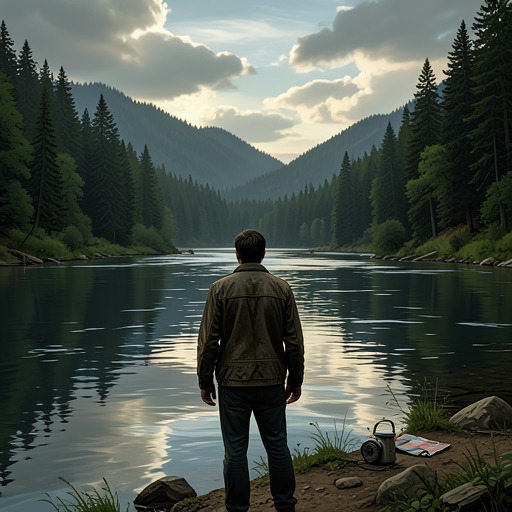
Over time, the boat becomes a source of freedom, and the river itself becomes an object of attachment. The narrator recalls not only the fish but the navigation signs, reeds, rushes, and drowning lilies; the changing light, wildfowl, and circles made by feeding fish; and the two islands and sloping fields around Oakport Estate. A clear, cold spring at the edge of the woods, wild mushrooms gathered by the bucketful, and the evening hounds at Oakport House also belong to this remembered landscape. Fishing places are embedded in an environment whose details exceed their usefulness to the angler.
The decisive value of these outings is finally not the size of the catch. The narrator identifies complete solitude on the river as more precious than any of the landscape’s other attractions. That emphasis recasts the practical business of setting lines and catching fish: the activity grants access to a stretch of time beyond the demands of work, prayer, and family life. Freshwater fish remain part of subsistence and companionship, but their recurring presence also marks how the river becomes the narrator’s chosen refuge.